Herizon Linux

Development candidate · Stable qualification underway

Local intelligence.
A desktop you control.

A bootable Debian 13 Linux distribution with an Xfce desktop, a small AI controller that runs on your CPU, grounded document help, and a software toolkit ready for disconnected work.

Latest built candidate: 1.2.0-rc1 / R11. A stable public download has not been announced.

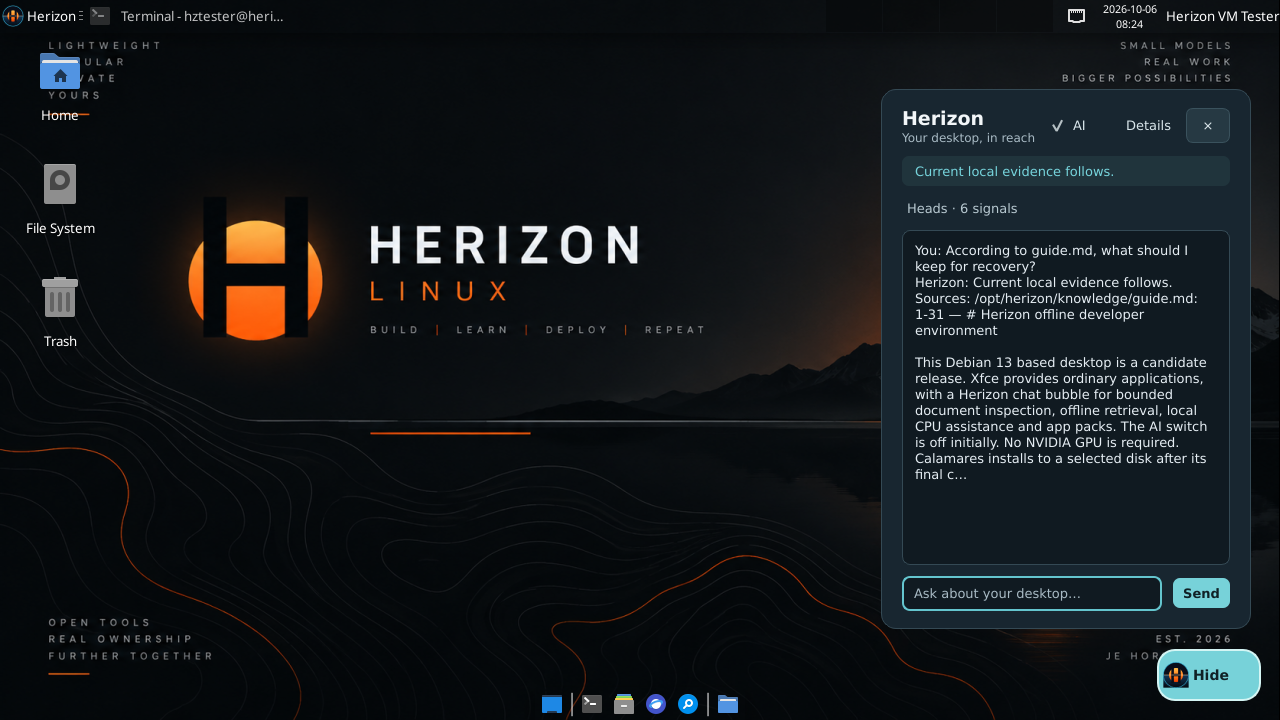
Actual Herizon Linux Xfce desktop with the official orange mountain wallpaper, dock and Chat bubble
Real R11 desktop, captured in an installed BIOS virtual machine on October 6, 2026. See the verification scope.
Debian 13 amd64 foundationXfce + LightDM familiar desktop0.6B controller CPU-local inference10 packs offline applications

A practical operating system.
With a different approach to assistance.

Herizon brings a maintained Linux foundation and local intelligence into the same distribution. The interesting part is how the system grounds answers, bounds actions, and lets you turn the AI off.

Linux foundation

A real desktop and disk installer

Debian 13, Xfce, LightDM and the Calamares installer provide the operating-system foundation. The current candidate has passed an actual BIOS installation and cancellation check, plus recommended-password onboarding.

On-device assistance

Small models with concrete jobs

Qwen3-0.6B Q8_0 runs locally on the CPU. A trained-head worker supports bounded workflows, while grounded retrieval gives the controller current document evidence instead of asking it to remember your system.

System boundaries

Inspect before acting

Candidate self-tests exercise typed reads, previews that do not dispatch actions, and refusals for stale, root, wrong-target and symlink cases. Evidence and a bounded tool path matter more than a confident-sounding answer.

User choice

AI that can actually stop

The installed CPU acceptance includes an explicit AI-off check and model-process teardown. Local AI and bundled offline software do not need a hosted inference service for the tested workflows.

Grounded answers.
Visible system evidence.

The current installed candidate can answer from a cited local document, exercise its trained-head worker, and return a typed read through the controller.

Its CPU acceptance checks fresh retrieval, a current cited answer, a preview without dispatch, observed-read receipts and refusal paths. Eleven candidate self-tests passed in the installed BIOS guest.

Q-RAG, native .MANIFEST file intelligence and a session core independent of chat are central to the next architecture. That integrated desktop and terminal design is approved and being implemented; it is not a shipped R11 feature.

Read how the local intelligence works
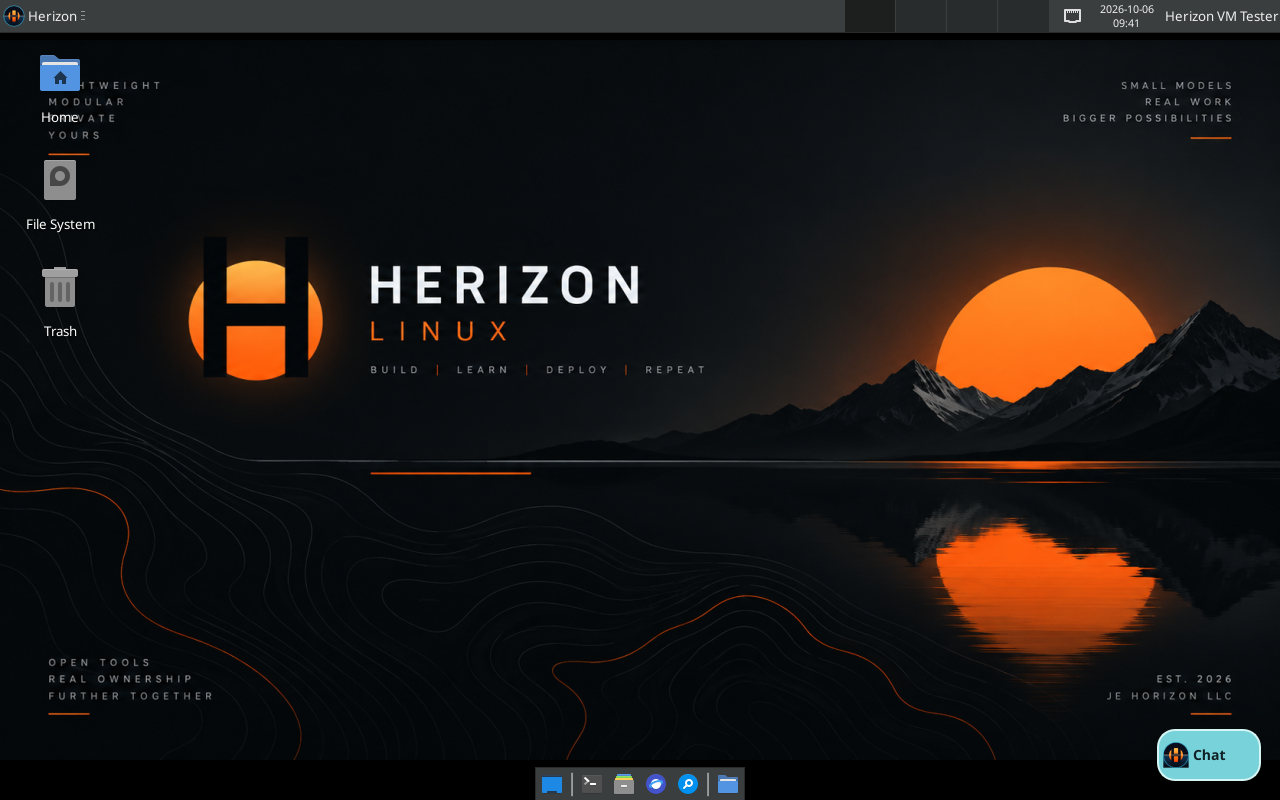
Herizon Linux candidate Chat window showing a response grounded in a cited local guide
Actual candidate document response. This demonstrates a tested local workflow, not unrestricted control of every application.
  1. 1. Ground

    Retrieve current local evidence for the answer.

  2. 2. Preview

    Inspect a proposed operation without dispatching it.

  3. 3. Bound

    Use typed operations and check the intended target.

  4. 4. Record

    Keep observed-read evidence and refuse invalid requests.

A useful toolkit, even when the network is gone.

Thirty core package selections and ten optional capability packs cover everyday work, development and specialist tasks. The current R11 BIOS guest installed all ten packs with APT downloads disabled and external routes absent.

Office

Documents and productivity

Creative

Visual and creative work

Development

Build, lint and inspect code

Internet

Connectivity applications

Media

Audio and video tools

Accessibility

Assistive applications

System

Desktop and system utilities

Games

Local recreation

Science

Scientific applications

Cybersecurity

Local inspection tools

Developer tools tested locally

Selected uv and Ruff fixtures passed in the installed candidate. The aim is to make a disconnected machine useful for real development work, with tools you can inspect and run yourself.

Security tooling with a stated scope

Selected Nuclei and Trivy fixtures passed locally. Those controlled tests do not establish production vulnerability-feed readiness or a complete security guarantee.

What the offline test proves: 226 of 226 selected packages were present: 30 core and 196 optional selections. It proves the tested installation path; internet-facing applications and fresh package or security updates can still need a connection.

Explore the toolkit and the release gates

The release is earned by testing.

Herizon Linux is in development. The current built candidate is 1.2.0-rc1 / R11; stable qualification remains open.

Public availability will be announced after the remaining release checks. No hardware compatibility or stable update-channel promise is made by the virtual-machine results.

Read the release evidence
  1. Verified in the installed BIOS candidateInstaller and cancellation, recommended-password onboarding, CPU controller acceptance, 11 self-tests, ten offline packs and selected developer/security fixtures.
  2. Next architecture in developmentIntegrated OS assistance, a persistent session core, per-user manifest intelligence and Shift+Tab assistance. Native Tab completion remains part of the shell design.
  3. Still required for stable qualificationInstalled UEFI use, two graceful disk reboots, installed signed-update and recovery acceptance, visual/accessibility fixes, and physical hardware checks.

Inside Herizon Linux.

Engineering stories about what works today, why the boundaries matter, and where the operating system is going.

Browse all JE Horizon blogs